
By Francis Rioux
Technical Representative at
Premium Industrial Group inc.
Revision date: June 10, 2026
-
Key takeaways
These elements are often associated with “height,” but they do not necessarily increase actual lifting height (the height reached by the load):
They can improve the installation, clearance under the overhead crane, or integration into the building — but that’s not the same as lifting the load higher.
At Premium, we see this regularly: some solutions seem obvious when you want to gain lifting height — and yet, they do not deliver the expected result. The consequence? Higher purchase costs without the desired outcome.
This problem should not be underestimated, because choosing the wrong solution can be expensive without solving the real issue.
In this article, we demystify three elements often associated with lifting height — but that do not contribute to it directly.
Why some solutions are confusing
When space is limited, every inch counts. That’s when certain solutions can seem logical for gaining height — but in reality, they serve a different purpose.
Some elements can be useful for adapting the overhead crane to the building, improving system integration, or freeing up space under the structure — without necessarily allowing the load to travel higher.
The nuance matters. A solution can be relevant for a technical reason without being the right answer to a lifting height problem.
Adapting the overhead crane does not always mean increasing lifting height
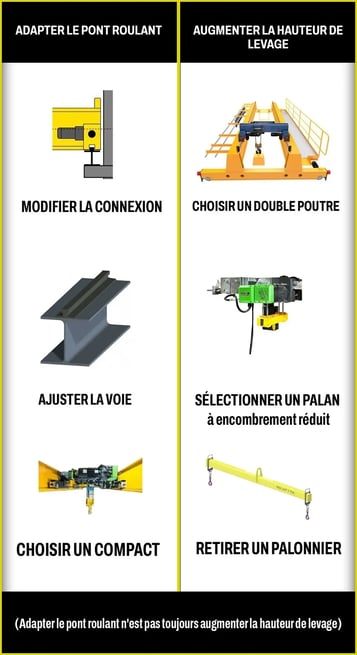 Before looking at the misconceptions, it’s important to distinguish between two things:
 - adapting an overhead crane to its environment;
- actually increasing lifting height.
1. Adapting the overhead crane can mean modifying the connection, adjusting the structure, accounting for an existing runway, or choosing a compact configuration. These decisions may be necessary to properly integrate the system into a building.
2. Increasing lifting height, on the other hand, means allowing the hook — and especially the load — to reach a higher position.
These two objectives can sometimes overlap, but that’s not automatic.
1. Runway height
The misconception
A common misconception is that the higher the runway is, the more lifting height increases. The idea seems logical: if the overhead crane is installed higher, people assume the load will automatically travel higher.
The reality
Runway height does not directly affect lifting height. The runway supports and guides the overhead crane — it determines the level at which the overhead crane travels. The overhead crane components, the hoist, and the accessories are what influence the actual height available.
.webp?width=1404&height=851&name=hauteur%20basse%20vs%20haute%20(impact%20sur%20crochet).webp) If the runway is too low, risers can sometimes be added — but these elements are mainly used to adapt the configuration to the existing structure.
If the runway is too low, risers can sometimes be added — but these elements are mainly used to adapt the configuration to the existing structure. -
What it actually changes
Runway height can influence:
- integration into the building;
- the type of components used on the overhead crane;
- clearance under the runway
-
Key takeaway: raising the runway can help operations. For example, if another piece of equipment, such as a garage door, needs to pass under the runway, this modification can help free up space. But it does not guarantee a real gain in lifting height.
2. The type of end carriage connection
The misconception
Some people may see modifying the connection between the end carriages and the overhead crane frame as a way to gain lifting height.
The reality
The type of connection generally depends on runway height and the building configuration. This connection is mainly used to adapt the overhead crane to its environment — not to increase lifting height.
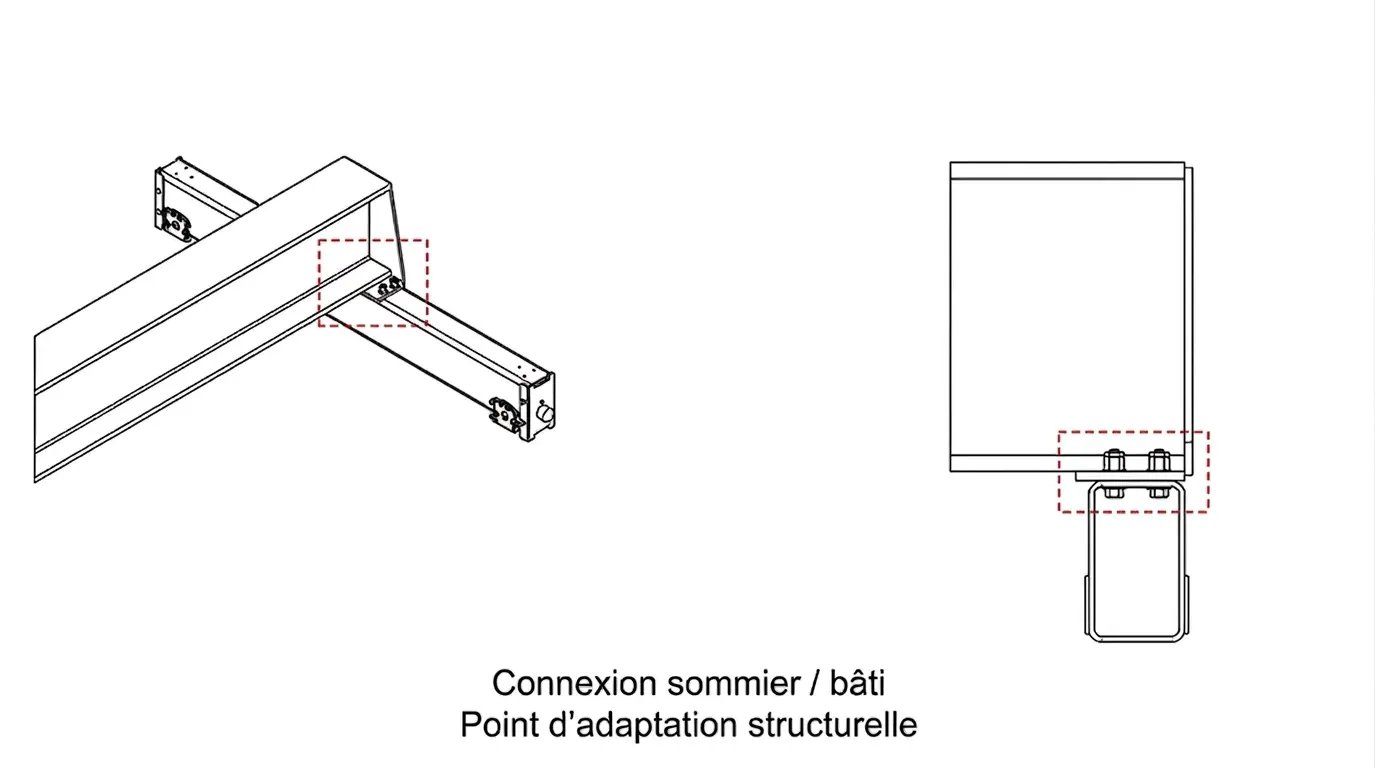
Changing the connection may be necessary for the system to work properly, but it does not create a real gain at the hook or load level.
What it actually allows
The type of connection can help:
- adapt the system to an existing runway;
- meet certain structural constraints;
- ensure proper mechanical integration;
-
It is therefore an important element — but it’s not the right starting point if the main objective is to increase lifting height.
3. The compact double girder overhead crane
The misconception
As explained in the article “The five solutions to increase the lifting height”, a double girder overhead crane can increase lifting height. But what about a compact double girder overhead crane? It is sometimes perceived as a solution for this issue. Its low-profile frame and hoist nested between the two girders can give the impression that it allows the load to travel higher.
The reality
The main purpose of a compact overhead crane is to free up space under the frame — not to increase lifting height. This configuration is very useful for improving clearance above equipment, fixed machinery, or shelving.
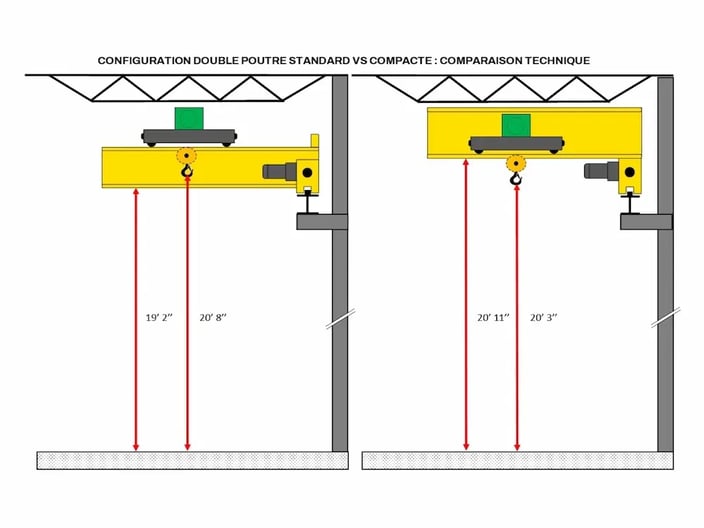 Because the girders are already positioned at the highest point, the hook often ends up in approximately the same place. The impact on lifting height is therefore low or nonexistent in many cases, depending on the full configuration.
What it actually improves
A compact overhead crane can improve:
- clearance under the overhead crane;
- travel above equipment;
- integration in a restricted environment;
-
These are important advantages — they simply should not be confused with a direct increase in lifting height.
Why these mistakes are common
These misconceptions have one thing in common: they confuse overhead crane integration with actual lifting height. An element can change the overhead crane’s position or the space available under the frame — without changing the maximum height reached by the load.
To avoid this confusion, the analysis should always come back to three questions:
- Where is the hook in the high position?
- At what height is the runway installed?
- How high can the load actually travel?
These questions help distinguish useful adjustments from changes that will not have the desired effect.
Conclusion: validate the real impact before deciding
Runway height, end carriage connection, and a compact overhead crane can all be relevant in a project — even essential, depending on the building constraints.
But they do not necessarily increase lifting height.
Before choosing a solution, clarify the real objective. Are you trying to lift the load higher? Free up space under the overhead crane? Adapt the system to an existing structure? This distinction helps avoid misdirected investments and focus the analysis on the right factors: clear height, overhead crane type, hoist selection, and lifting accessories.
Next logical step: if you are looking for solutions that actually increase height, see “The five solutions to increase the lifting height”.
And finally, if needed… Talk to a Premium specialist to quickly validate what is limiting your height — building, hoist, or accessories — before modifying the configuration.