
By Jonathan Cadotte
Service Manager at
Premium Industrial Group inc.
Revision date : june 10, 2026
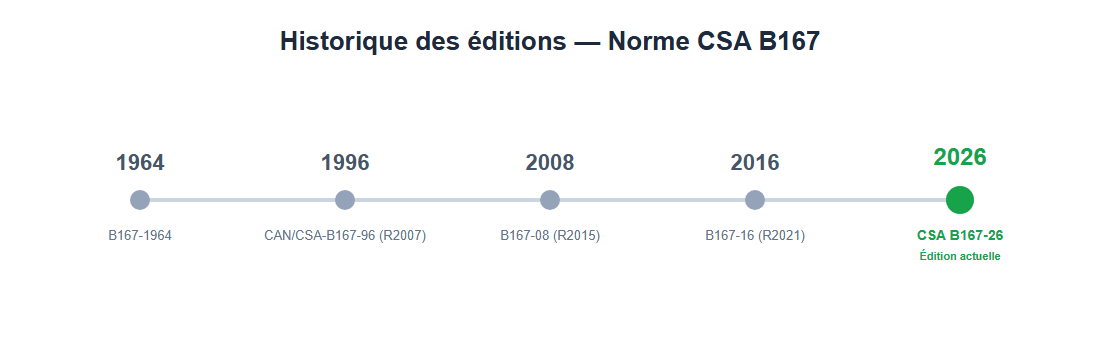
This new version of CSA B167 introduces changes that may affect your overhead crane operations.
In Canada, CSA B167 is the overhead crane standard that defines the responsibilities of owners and manufacturers. Did you know the committee of this standard has just released a new revision.
CSA Group is a standards development organization whose mission is to improve the lives of Canadians by advancing standards in the private and public sectors. It convenes experts and users to periodically review standards in line with evolving markets and technologies. For CSA B167, the experts come from the lifting industry: manufacturers and service providers, regulatory authorities (such as the CNESST), users, and other stakeholders.
Some changes are minor, but others warrant closer attention. After reading this article, you’ll be familiar with some of the key changes in this new edition and the first steps to address them promptly.
 Classes of use and inspection frequencies
Classes of use are still included in the new version of the standard, but—if we put it in hockey terms—the lines have been reshuffled. This will mainly affect the recommended minimum frequencies for frequent and periodic inspections, as well as the protocols to follow after a period of equipment inactivity.
Summary of inspection frequencies by lifting equipment class
| Class | Frequent inspection | Periodic inspection |
|---|---|---|
| A – Infrequent service | Semi-annually | Annually |
| B – Light service | Monthly | Annually |
| C – Moderate service | Monthly | Annually |
| D – Heavy service | Monthly | Semi-annually |
| E – Severe service | Weekly | Quarterly |
| F – Continuous severe service | Daily | Quarterly |
| Unclassified or special service | In accordance with the manufacturer’s or an engineer’s recommendations. | |
Replacement remote control management
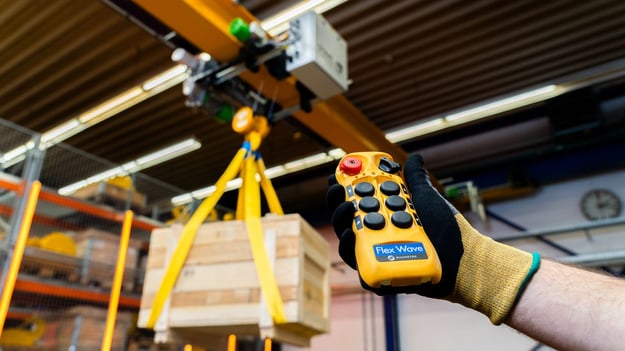
It’s no secret: technology evolves faster than standards and regulations. Twenty years ago, few overhead cranes were equipped with wireless remote-control systems. Today, it’s a different story. A good majority of standard overhead cranes in Quebec are now delivered with this type of remote.
The new version therefore adds a section to ensure proper management of replacement transmitters. It also requires an accurate transmitter inventory, and documented replacement/activation procedures.
To learn more : How can I ensure safety when using spare remotes on my overhead crane?
Technician qualifications
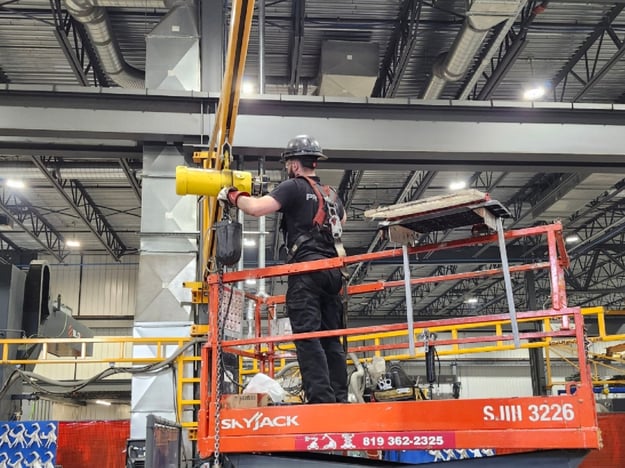
Given the absence of a national training and competency management program, the committee chose to maintain a minimum experience-hour requirement. While experience is an important factor in developing skills, it cannot, on its own, guarantee competence. It’s therefore up to the employer to confirm technicians’ competencies in this area.
It should also be noted that technician supervision requirements remain unchanged.
Qualifications for overhead crane technicians/inspectors
In 2016, technicians had to be industrial mechanics, electromechanics, or hold equivalent qualifications approved by a competent authority. This made the third option difficult to meet, even for an electromechanical technician (a trade that is very common in Quebec, but far less recognized in other Canadian provinces). This requirement was replaced with “an equivalent qualification in terms of skills and knowledge.” On this point, employers remain responsible for competence.
As for the 8,000-hour requirement for inspections and 4,000-hour requirement for repair work, both remain in place in the 2026 edition.
Qualifications for explosion-proof overhead crane technicians/inspectors;
Qualifications for explosion-proof overhead crane technicians/inspectors;
Although this type of equipment is relatively rare in Quebec, it’s important to note that the standard clearly states the need for personnel specifically trained on this type of equipment to perform inspections or repairs. Experience hours alone are no longer sufficient. If you have this type of equipment in your fleet, it may now be difficult to find a technician with the required competencies.
Employer responsibilities regarding the qualifications of overhead crane inspectors
Although the employer has always been ultimately responsible for ensuring employee competence, responsibilities for inspectors are now more clearly defined in Section 6.2.2.2.
It’s now up to the employer to demonstrate that personnel assigned to inspect lifting equipment covered by CSA B167 have the necessary competencies.
They must now document the following :
- Knowledge of overhead crane operation and components.
- Ability to identify major defects, improperly assembled components, and signs of improper use.
- Signs of wear and non-compliant components.
- Knowledge of applicable standards.
- Ability to interpret technical documentation.
- Ability to be precise in reports, issue sound recommendations, and develop a follow-up plan for required corrections.
This provides a somewhat clearer guideline on the competencies required to perform inspections.
When it comes to repairs, the standard remains essentially the same as the previous version.
Tandem lifting
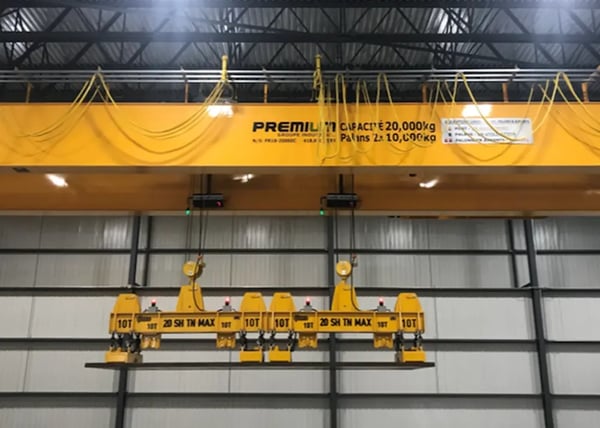
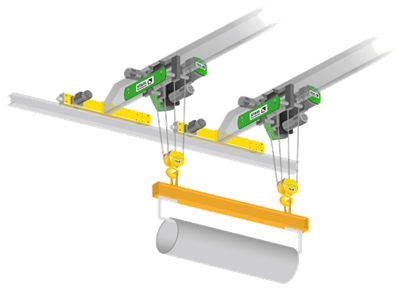
Do your operations require the use of more than one lifting device? If so, the following section may require you to document things more thoroughly. A major new feature in this updated version: the committee now provides a definition for “tandem lifting” (more than one overhead crane or hoist, or an overhead crane or hoist used with another powered lifting device) and now states that these operations must be subject to specific planning, in accordance with the ASME P30.1. standard In most cases, this means a written lift plan and trained operators.
To learn more : Is tandem lifting dangerous? Master its unsuspected dangers!
CSA Certification
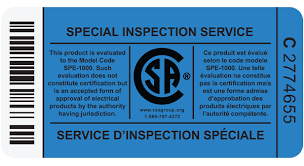
The Canadian Electrical Code already specifies the requirement to use approved equipment. The CSA B167 committee has now chosen to be more specific and clearer on this point. In its new edition, the standard states (Section 5.7.2) that overhead cranes must be approved as a complete system. Until now, some manufacturers used approved parts but did not take the steps required to have the entire system approved (through a a SPE-1000 approval performed by a third party, for example). This clarification is welcome. To avoid issues with future equipment purchases, make sure to ask your supplier for proof of this certification..
Displaying load limits on the supporting structure
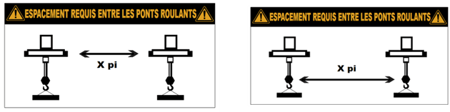
Have you ever added new equipment to an existing crane runway in your facility? If so, do you know whether any capacity limitations exist on the supporting structure? Overhead crane supporting structures are normally designed to support the rated capacity of the crane(s) they were built for. Sometimes, however, these structures may have limitations (which don’t necessarily represent a non-compliance) that are too often unknown to operators. To improve safety, the CSA B167 committee added a requirement to identify these potential limitations on the runway. A permanent, clear, and visible sign for the operator is now mandatory.
To learn more : Capacity restriction on overhead crane structure: 3 solutions
Summary table
| Topic | Section | Summary |
|---|---|---|
| ADDITION | ||
| Tandem operation | 7.6 | Have a lifting plan compliant with ASME P30.1 for tandem lifts. |
| Management of spare remote controls | 7.5 | Requirement to have a procedure for replacing or activating remote controls. |
| CSA certification | 5.7.2 | Requirement for CSA approval of the equipment as a complete system. |
| Display of limitations for the supporting structure | 5.3.5 | Permanent, clear, and visible display of supporting structure capacity limits. |
| Bolts and bolted connections | 5.3.4.5 | Specifies bolt type requirements and reuse conditions. |
| Employer responsibilities for inspector qualifications | 6.2.2.2 | Documentation the employer must provide regarding inspector competencies. |
| MODIFICATION | ||
| Qualifications of overhead crane technicians and inspectors | 6.2.1.1 6.2.2.1 |
Adjustments to qualification requirements for technicians and inspectors |
| Class of use and inspection frequency | Table 2 | Update to the recommended inspection frequencies. |
Conclusion
This article highlights major changes in CSA B167 for the new 2026 edition, but not all of them. While I have tried to remain as neutral as possible regarding these changes, I can only recommend you obtain the new version of the standard to review it directly – beyond the condensed summary provided here.
For now, it’s available in English only, but the French translation committee will be meeting soon to work on the translation, which should – hopefully - be available by the end of 2026.
As I mentioned at the beginning of this article, my colleagues and I will make sure to cover these topics in greater depth over the coming weeks. If, in the meantime, you encounter any issues, your overhead crane service provider should be able to answer your questions or do the research needed to help clarify how the changes apply to your situation.