
Marc-André Martineau
Manager & Partner Premium Industrial Group inc.
Installing a hoist in a paint booth may seem like the ideal solution for lifting heavy parts.
However, when people ask me which model to choose, my answer is almost always the same : NONE !
Surprising, isn't it, especially coming from an overhead crane manufacturer like Premium Industrial Group?
In this article, you will discover why a hoist is often not the best option in this type of environment, and what solutions allow you to work safely despite the risks of explosion or auto-ignition.
You will learn what alternatives exist, how to evaluate which one is best suited to your situation, and what steps to take to move forward with your project.
What is the problem with installing
a hoist in a paint room?
When you want to handle heavy parts for painting, you might think that all you need to do is install explosion-proof equipment inside the paint booth. Unfortunately, it's not that simple.
For your lifting system supplier to choose the equipment best suited to your situation, your paint booth must first be classified by an expert according to the type of hazard. That being said, it's important to note that the cost of an electric hoist for a paint booth is considerably higher than that of a hoist used in a non-flammable environment. In fact, you should expect to pay about three to four times more than you would for a standard electric hoist!
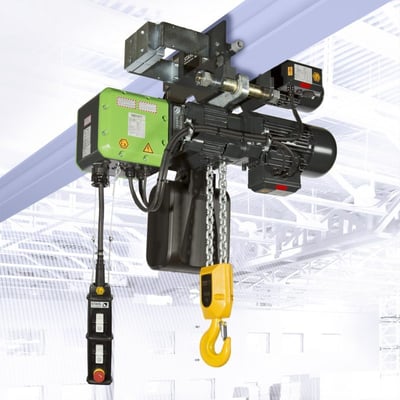
Explosion-proof electric chain hoist
Who should classify the hazardous area of a paint booth?
Paint spray booths are generally designed in two ways. The first involves using a booth prefabricated by an original equipment manufacturer (OEM), built in accordance with the requirements of NFPA 33 for flammable or combustible materials. Generally, the manufacturer classifies the booth and the equipment located inside it.
The second option is a custom-built or handmade booth. In this case, it's important to consult an expert in hazardous area classification to correctly determine the type of area represented by the paint booth and to comply with all applicable standards, including NFPA 33.
According to the Régie du bâtiment du Québec (RBQ), the assessment of a hazardous area must be carried out by a qualified professional with the necessary expertise. Without this step, the booth may not be approved by the competent authority or the company's insurer.
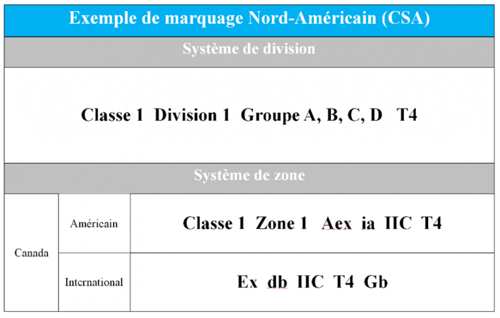
Here is a list of the information needed to determine the classification of your hazardous area. Make sure that the professional chosen to classify your area collects the following information :
- Location of devices in the room
- Flammable vapors present
- Maximum surface temperature of equipment (for auto-ignition prevention)
- Any other information specific to your situation (e.g., ventilation in the room)
ALL DEVICES MUST BE CLASSIFIED, EVEN THE REMOTE CONTROL!
It's not only hoists that must have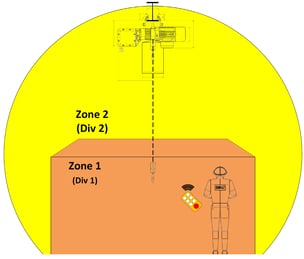 the appropriate classification for the paint booth. In fact, any equipment used within the flammable area must be classified according to the expert's recommendation.
For example, if a hoist used outside a paint booth is controlled by an operator located in the hazardous area, the remote control must have the appropriate classification for that area.
A remote control can indeed produce sparks. Even its protective case could cause an accident by generating static electricity through friction!
Wouldn't an air hoist be the ideal solution since it has no electrical components?
Our page dedicated to explosion-proof overhead cranes explains that even the components of a pneumatic hoist must be classified as spark-proof as a minimum to prevent any risk of explosion. Therefore, even an air hoist must be designed for environments with a risk of explosion.
Plus, air hoists use a lubricated air system, and it's not uncommon for fine droplets to escape from the filtration system. This type of lubricant could settle on surfaces and affect the paint finish.
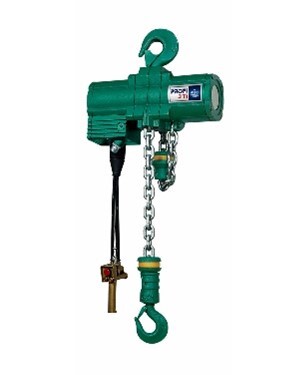
Explosion-proof air chain hoist
Given the complexity of such a project, what would be the ideal solution for handling heavy parts in a paint booth? Let's take a look at the options available to you.
What are the recommended solutions for handling heavy parts in a paint booth?
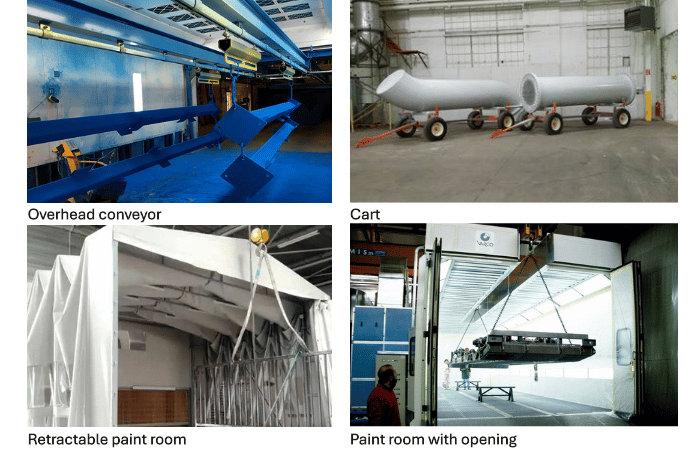
In fact, a hoist in a paint room is not the only solution available on the market. Other options exist for moving and handling heavy loads to paint. Often, a combination of different equipment can be used depending on the specific needs of your production process.
For example, in some cases, it's possible to lift parts outside the paint room. Products can be moved using a hoist or overhead crane and then placed on a trolley before being transported to the area where they will be painted.

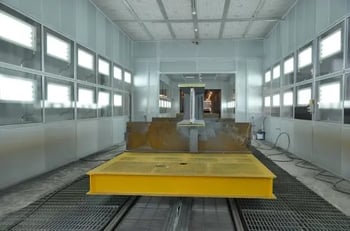
Rail-mounted trolley Trolley moved by a forklift truck
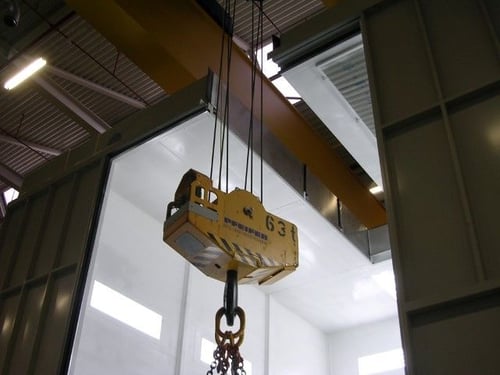
There are also systems such as overhead conveyors for bringing heavy parts into the paint booth. Other options are directly related to the design of the paint booth. For example, some booths have an opening in the ceiling to allow a hoist to bring in the parts to be painted. Other booths are retractable, allowing the part to be positioned outside and then the booth to be closed around it.
Obviously, before choosing the right lifting solution for a paint booth, you need to carefully assess your needs with a painting process specialist.
The steps to find the right lifting solution for painting your equipment
Step 1 – Check the best practices for your environment
Talk to painting process specialists to identify the method that best suits your situation. Here are a few suppliers you may want to consider :
-
-
Overhead conveyor (painting line) : Smak Manutention,
-
Retractable paint booth : Duroair,
-
Any paint booth supplier
-
Step 2 – Classify your environment
Does the lifting equipment need to be classified? Only a hazardous area expert can determine this. If classification is required, here a few engineering consulting firms that offer this type of service :
-
-
Beaulier Inc
-
EXP
-
CIMA+
-
Etc.
-
Step 3 – Contact a lifting specialist
Whether for lifting operations outside or inside the paint booth, a lifting specialist will then be able to work with you to analyze the equipment best suited to your environment.
In the case of an environment classified as hazardous, a report with the classification of the environment will be required to ensure compliance and safety of operations.
Ready to implement your own lifting solution for your paint booth!
We have seen that, contrary to popular belief, in most cases, the solution is not to install an electric or pneumatic hoist inside your paint booth. Although there may be exceptions, the complexity of installation and the high costs of this type of solution encourage us to explore other, more optimal options. This could be, for example, the use of a hoist outside the booth combined with the use of trolleys, overhead conveyors, a retractable paint booth, or a booth with an opening in the ceiling.
But the right solution will always involve three fundamental steps: checking best practices, classifying the hazardous area, and then working with your lifting specialist to develop a suitable solution.
The Premium Industrial Group can also help you find the best solution. Feel free to contact one of our specialists to be directed to the right expert and the equipment suited to your needs. If, after considering all the options, you opt for an explosion-proof hoist, we will be be happy to help you choose the appropriate equipment based on the classification of your hazardous area.