
By Marc-André Martineau
Manager & Partner at
Premium Industrial Group inc.
In short : a 2-speed contactor is often the best choice if you're looking for a simple, cost-effective, and easy-to-maintain solution. A VFD is preferable if you need finer control, very low speeds, or a more demanding duty cycle. In some cases, the right choice also depends on the motion involved : overhead crane, trolley, or hoist.
The goal, therefore, isn't to install a VFD everywhere, but to choose the technology that truly meets the intended use and to clarify whether the proposed choice genuinely reflects your operational needs, or simply the limitations of the supplier's standard catalog.
When should you choose a VFD? When is a contactor sufficient?
A 2-speed contactor is often sufficient when :
- simplicity is the priority;
- the cost must be kept low;
- maintenance should remain accessible;
- the application does not require very precise control.
A VFD is often worthwhile when :
- motion precision is important;
- a very low speed is required;
- the duty cycle is high;
- the speed must adapt to the actual production rate.
If requirements vary depending on the motion, or if issues related to precision, wear, and maintenance are more critical, the application must be evaluated in greater detail.
What is an overhead crane VFD?
A variable frequency drive (VFD) is an electronic system that enables control of a motor’s speed and adjustment of its acceleration and deceleration profiles.
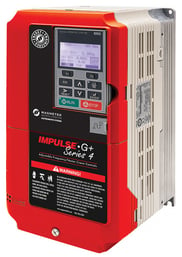
Variable Frequency Drive (VFD)
On a lifting device, it can be used on the overhead crane, the trolley and, in many cases, the hoist. Its main advantage is that it provides better motion control. Instead of being limited to two fixed speeds, the operator can use an intermediate speed as needed.
This can be compared to a dimmer switch: instead of only “low” or “high”, it provides intermediate speeds as needed.
To illustrate the types of solutions available on the market, we can also look at some manufacturers that offer variable frequency drives for lifting applications, such as Magnetek, Schneider Electric and Danfoss.
That said, configurations and limitations vary from one manufacturer to another. It’s therefore essential to understand the main speed control systems used on overhead cranes before comparing solutions.
What are the main speed control systems used in an overhead crane?
There are essentially two main approaches :
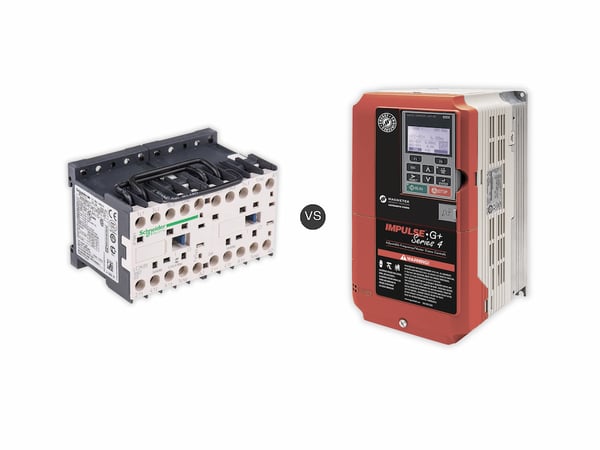
1. The 2-speed contactor system
The motor has two windings, each corresponding to a different speed: low or high. This technology is simple, proven and well-suited for many applications where precise control is not required.
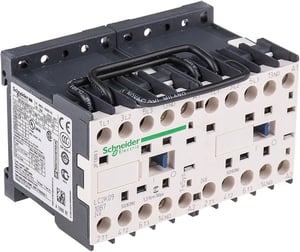
Inverter contactor
2. The standard VFD
The VFD combines a suitable motor with a drive unit that controls frequency. This allows for programmable acceleration and deceleration and offers greater speed flexibility.
3. Certain more limited VFD configurations
Some configurations operate on the same principle as a VFD, but with more limitations, particularly regarding minimum speed, speed ratio, or duty cycle. They therefore do not always produce the same results as a standard VFD.
It should also be noted that performance varies depending on the motion. For overhead crane and trolley movements, a standard VFD generally allows for a wider speed range than a contactor-based system. On a hoist, the difference can be even more pronounced.
Comparison chart of different travel speed systems
|
|
2 Speeds
 |
Variable |
Variable exclusive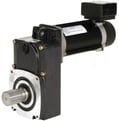 |
|---|---|---|---|
|
Manufacturer |
Stahl, GH, Kone, R&M |
GH, Stahl, Tundra |
Kone, R&M, Dema |
|
Control |
Contactor |
Standard variable frequency drive (VFD) |
Exclusive variable frequency drive (VFD) |
|
Price |
Stahl : Standard GH, Kone, R&M: Optional |
GH, Tundra : Standard Stahl: Optional |
Kone, R&M, Demag: Standard GH, Stahl, Tundra: Not offered |
|
Ratio between high and low travel speeds |
4:1 |
10:1 |
4:1 |
|
Acceleration and deceleration |
Cylindrical motor with inertia |
Programmable |
Programmable |
|
Speed range (based on a maximum speed of 25 m/min)
|
6,3 and 25 m/min
|
2,5 to 25 m/min
|
6,3 to 25 m/min
|
|
Control position 1 (0-1 = accel./decel. ramp)
|
0 to 6,3 m/min
|
0 to 2,5 m/min
|
0 to 6,3 m/min
|
|
Control position 2 (1-2)
|
Range of 6,3 to 25 m/min
|
Variable between 2,5 and 25 m/min
|
Variable between 6,3 and 25 m/min
|
|
VFD manufacturer
|
N/A |
Magnetek / Schneider / Vacon (other manufacturer on request)
|
Variable depending on year of manufacture
|
|
Motor duty cycle
|
40/20%
|
60%
|
40%
|
|
Motor enclosure
|
T.E.F.C. Totally Enclosed Fan Cooled
|
T.E.F.C. Totally Enclosed Fan Cooled
|
T.E.N.V. Totally Enclosed Not Ventilated
|
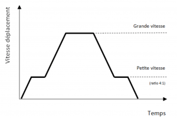
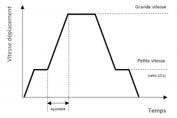
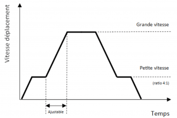
Note : The values above apply to the travel motions of the overhead crane and the trolley. For a hoist, the reference points are different. A contactor-based system typically offers a ratio of 6:1, while a VFD can achieve a ratio of up to 50:1, depending on the motor.
Advantages and Disadvantages of VFD vs. a Contactor
Key Advantages VFD:
- Better motion control
This advantage is particularly useful when the application requires precision. - Enables very low speeds
This is often a key factor for certain more delicate operations. - Improved adaptation of speed to the production cycle
The equipment can be operated more slowly or more quickly depending on the actual operating conditions. - Reduced wear in demanding, high-duty applications
This advantage is particularly relevant for equipment under heavy use.
Main drawback of the VFD
The VFD is a more advanced technology. When it malfunctions, troubleshooting can be more complex for a non-specialized technician. Therefore, the availability of maintenance resources must also be taken into account.
Main advantages of a 2-speed contactor :
- Simple technology
- Accessible and affordable parts
- Easier maintenance
- Cost-effective solution
In practice, a poor choice doesn’t just cost money. It can also compromise accuracy, increase wear and tear in certain situations, complicate maintenance, or hinder the smooth running of operations.
Common misconceptions
“ A VFD allows you to vary the speed between 0 and the maximum speed ”
False. There is always a minimum speed specific to the motor and the configuration used.
“ The VFD works exactly like a dimmer switch ”
Not quite. The analogy helps convey the general idea, but the system also relies on frequency, a suitable motor, a braking resistor, and specific programming.
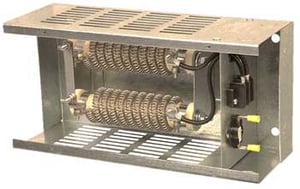
Braking resistance
“ All VFDs are the same ”
False. Certain combinations of motors and drives have limitations that may be suitable for one application but not for another.
In conclusion: How do you choose between a VFD and a contactor for an overhead crane?
The decision depends primarily on :
- the required precision;
- the desired minimum speed;
- the duty cycle;
- the available maintenance resources;
- the specific motion involved.
If your priority is simplicity, lower cost, and easier maintenance, a 2-speed contactor is often the right choice. If your application requires greater control, flexibility, or adaptation to the production pace, a VFD can provide real value.
The choice between a VFD and a contactor should never be made in isolation. Before deciding, assess the actual level of use, precision requirements, and maintenance context to select the solution that best supports your operations.
Next step :
- See also : What are crane and hoist classifications? How do they affect you?
- Consult a specialist : confirm your application and priorities to select the best option before the final quote.