
Par Marc-André Martineau
Directeur & Associé chez Groupe Industriel Premium
In short…
Overhead crane classifications represent the intensity of work of your equipment according to its use. Information must be gathered by the equipment owner in order to evaluate it. Determining the class of use enables you to purchase the right overhead crane for your operations, in order to limit the production stoppages and the associated costs. It also enables you to determine maintenance frequency and estimate its service life.
Read the article to find out more!
You buy an overhead crane to lift 5-ton parts to a height of 20'. The installation went well and you started using it. But soon, emergency service calls begin to multiply due to premature wear and frequent breakdowns !
Yet you respect the equipment's capacity and maintain it. Is it bad luck? Is it a manufacturing defect? Then, upon further investigation, you are informed that your overhead crane doesn’t have the right class of use for your needs.
Little things are more frustrating than spending money on the wrong product. If you invest $40,000, $50,000 or $100,000 on the wrong equipment, you’ll be left with disappointment, regret, and great consequences :
• Premature wear
• More frequent breakdowns
• More frequent maintenance
• Reduced productivity
After reading this article, you'll understand why classification is a determining factor in the selection of your overhead crane, and therefore in your satisfaction.
We'll explain :
• What are overhead crane classifications? We'll demystify it for you.
• How do classifications affect you?
This will enable you to determine your exact needs and acquire the equipment best suited to you, based on the appropriate class of use. This will ensure a secure and profitable investment.
| Consequences of using the wrong class of use |
 Let's start by understanding what is a class of use, and what it represents for you.
What are overhead crane classifications?
The class of use is a way of classifying lifting equipment based on the use to which it will be put, or the intensity with which it will be used. It can range from light to extremely heavy.
Equipment is classified according to precise criteria and calculations, such as load cycle, average load, intensity, etc.
But to keep things simple: if an overhead crane is not used often during the day, week or year, it may be in the "light" class. On the other hand, if it's used a lot, then it will be in a higher class, perhaps "medium" or "heavy".
The following table gives an idea of the general classification of lifting equipment.
| Classification (CMAA) | Usage | Details on equipment usage |
|---|---|---|
| Class A |
Light |
Not used often with very light loads |
| Class B | Light | Not used often, but maximum load lifted occasionally |
| Class C | Light to medium | More frequent use, maximum load lifted occasionally |
| Class D | Medium to heavy | Frequent use and heavy loads lifted regularly |
| Class E | Extremely heavy | Constant use and heavy loads lifted regularly |
| Class F | Extremely heavy (Continuous) | Loads lifted continuously. Customized design |
Now, what's the difference between lower- and higher-class equipment?
What makes the equipment different from one class to the next?
The design of the lifting equipment is what differs. In concrete terms, this means that the overhead crane's mechanics will be designed for the job it has to do, regardless of the maximum capacity it will be capable of lifting. If the equipment has to lift parts more frequently, especially if the weight of the parts is close to its maximum capacity, it will be designed with sturdier materials and parts than if it lifts parts less frequently.
To illustrate, let's say you're a strong man who carries rocks all day long. You can lift up to 250 kg! But how many times will you lift that weight in a day before you collapse and have to take a whole month off ?
|
What is the relationship between the overhead crane's rated capacity and its class of use? In fact, these are two distinct but important elements in the choice of equipment. Rated capacity is the maximum capacity for which your overhead crane has been designed. The class of use is the intensity at which your equipment will work. |
Similarly, it's true that the equipment you choose will have to be capable of lifting your plant's heaviest load (which represents the rated capacity of your overhead crane). But how often will it lift this heavy load ? What weight will it lift most often ? All this analysis goes into determining the class of use.
To understand better, let's take a look at some concrete examples.
Some concrete examples of overhead crane classifications
Here are 2 examples showing the difference between classifications depending on the application and the type of industry.
Example 1 - handling tool - light class
Here's a piece of equipment used by a majority of industries.
• Maximum load: 10 tons
• How often the maximum load is lifted: rarely
• Usual loads: 2 to 7 tons
• Frequency of use: occasional
• Number of lifts: 15 to 20 per day, 5 days a week
• Type of equipment: handling tool
Class : LIGHT
Example 2 - production equipment - heavy class
Here's a piece of equipment used to feed a machine and forming part of a production line.
• Maximum load: 10 tons
• How often the maximum load is lifted: regularly
• Usual loads: 7 to 10 tons
• Frequency of use: regular, even during vacations.
• Number of lifts: 250 times a day, 7 days a week
• Type of equipment: production equipment
Class : HEAVY
2 overhead cranes 15 000kg
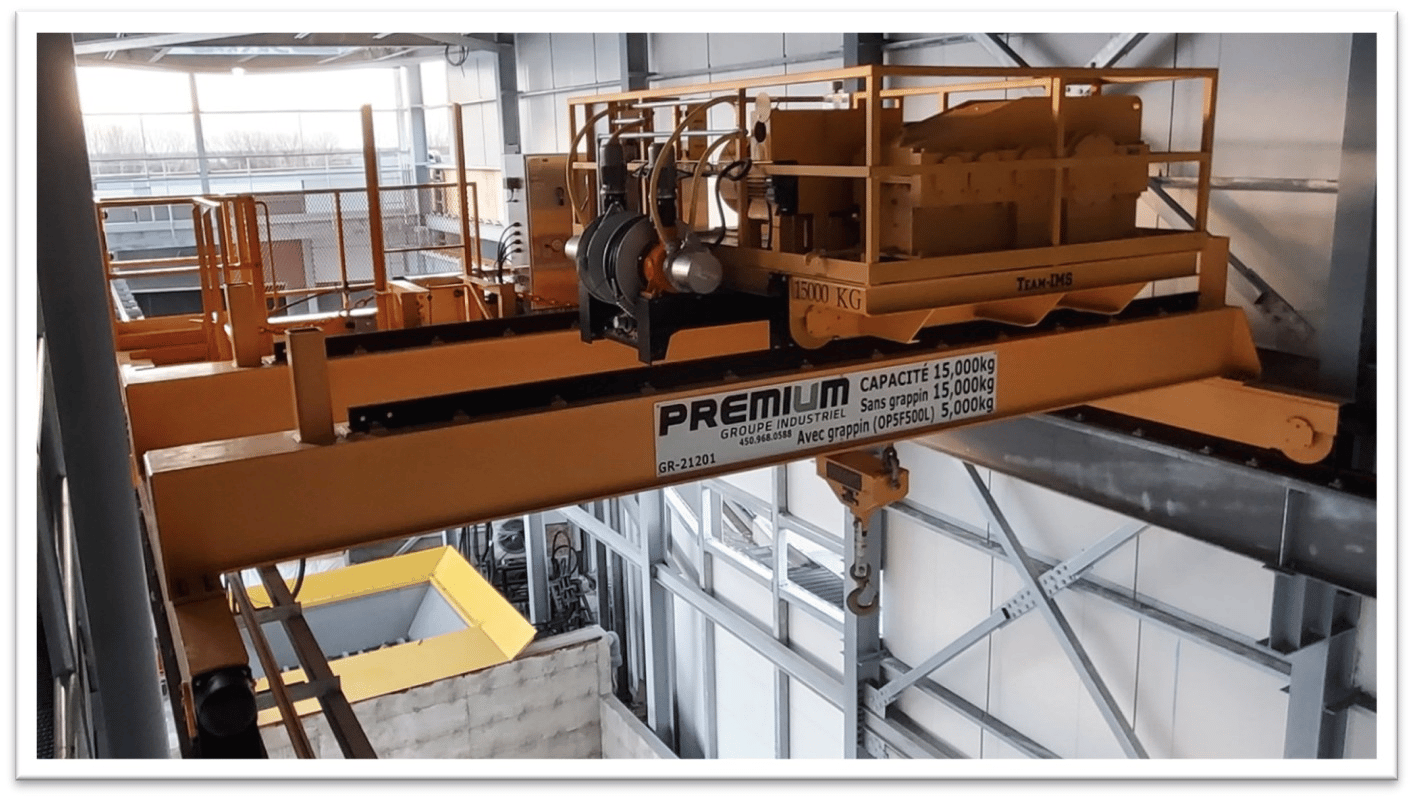
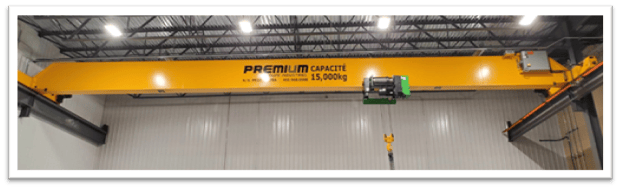
As we can see, the equipment in the two previous examples have a rated capacity of 10 tons. But they are not in the same class of use, because their application is totally different. These two pieces of equipment will not be the same in their mechanical design, and obviously their acquisition cost will not be the same. Example 2 will cost more than Example 1. That's one of the reasons why this subject is relevant to you.
How are you affected by overhead crane classifications?
The classification of lifting equipment is not just a label. It enables the future owner to achieve 2 important objectives :
1. Select the right equipment for the right purpose
2. Establish an appropriate maintenance schedule.
First, let's talk about overhead crane selection.
Why does selecting the right class of use allow for a better investment?

Selecting the right class of use for your overhead crane ensures the best investment. Why is that? Because the true cost of a machine is not only its purchase price, but also the maintenance and downtime costs over its lifetime.
The real cost of a machine is not only its purchase price, but also the maintenance and downtime costs over its service life.
In other words, in the case of heavier classes, even if the price of the overhead crane is initially higher, the number of unplanned service calls will be reduced. This means fewer repair costs, and more importantly, fewer costly production stoppages. In these cases, a new, more expensive overhead crane but suited to its use is actually a better investment.
This principle can also be applied to the replacement of an existing overhead crane. It may be tempting to replace the existing overhead crane with an equivalent configuration. This solution may have met the need at the time the choice was made. But today, your lifting needs may have changed. Or perhaps the original equipment itself didn't really meet the needs for the application. If so, you may have spent more than you should have in maintenance and downtime costs ! If it wasn't done then, it certainly makes sense to do it now.
|
What is the service life of an overhead crane? An overhead crane has a service life of around 20 to 40 years, depending on its use. Although manufacturers define a theoretical service life, its practical life depends on how intensively it is used. The assessment of the service life must therefore consider wear and tear, repairs, the context of use and the equipment's vocation over time. Let's take the example of a car : If it runs mainly on a well-maintained freeway, in a temperate climate, and is serviced according to the manufacturer's recommendations, it will last a long time. But the same car, if poorly maintained, used intensively on bumpy roads and in harsh climatic conditions, will wear out much faster. |
Once you've selected your lifting equipment, maintenance should be well planned to avoid unplanned production stoppages. How can classifications help you in this area?
How does the class of use influence the maintenance schedule?
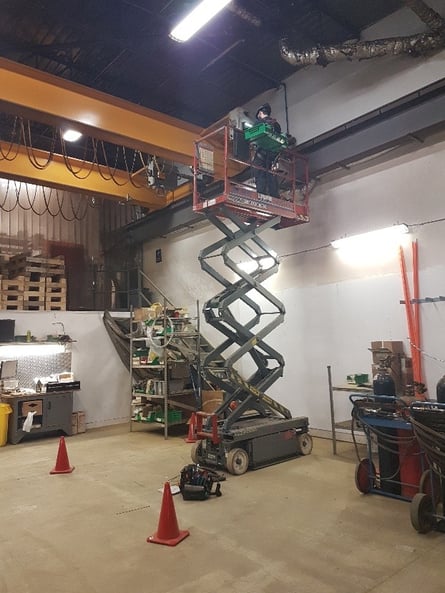 The harder your overhead crane works, the more frequent its maintenance needs to be. The class of use therefore influences the maintenance schedule. Just as an Olympic athlete will not have the same lifestyle habits as an amateur athlete, a heavy-duty crane will not have the same maintenance schedule as a light-duty crane.
For example, we often hear that an overhead crane needs to be inspected at least once a year. This is true for light duty classes. But the higher the class of use, the more frequent the planned maintenance. Your specialist will be able to advise you on the maintenance required for your new lifting equipment, depending on its class of use.
But is it worth classifying an existing overhead crane? In some cases, yes. For example, when an existing crane is suspected of being over-used, calculating its actual classification will help to re-establish the right maintenance schedule to minimize future maintenance costs.
But how complicated is it to determine the class of use? There are many elements to consider. That's why you'll certainly need the help of your specialist. But you do have a role to play. Which one?
Your role in determining the right class of use for your needs
Your specialist will base his assessment of your lifting equipment's class of use on the information you provide. What will he need from you?
The following table lists the information he may ask you to gather, depending on your situation:
| Information to gather |
|---|
| Weight of the parts to be lifted |
| Percentage of lifts for each weight |
| Average number of lifts per day |
| Approximate number of lifts per hour |
| Number of typical shifts involving the overhead crane |
| Number of days the overhead crane is used per year |
| Average lifting height |
| Etc. |
If you don't know the answers to some of these questions, don't worry! It's often possible to gather this information from production data already available.
For example, a transport company will usually know how often it loads and unloads materials, or how often these materials are handled. This kind of register can often be used as a source of the information required to establish the right class of use.
Choosing an overhead crane with the right class of use: an essential step
You have now learned about classifications and the fundamental role they play in your equipment selection.
Given the risk of making the wrong choice of equipment, which could end up costing you a lot of money, selecting your overhead crane based on classifications is an essential step. So, what can you do now to ensure you make the right choice?
The first step to choosing the right overhead crane is to gather the information you need to analyze your options with your specialist. To this end, you can consult the article "Need an overhead crane: Where to start?", which will guide you through the process. You'll also find a downloadable form that you can use as a checklist to make sure you haven't forgotten anything.
If you wish, you can then contact one of our specialists. The Industrial Group team has all the tools at hand to help you determine the appropriate class of use for your overhead crane. Simply click on the "Contact a specialist" button at the bottom of this page.