
Revision date: May 29, 2026
By Marc-André Martineau
Manager and partner at Premium Industrial Group
In briefNeither type is superior to the other: the application is what decides. Wire rope hoists are the clear choice for loads over 7,500 kg and high production rates. Chain hoists are preferable under 2,000 kg, in tight spaces, and for true vertical lift. Between 3,000 and 5,000 kg, both options are comparable and the specific need is the deciding factor. On budget, expect roughly $3,000 to $4,000 more for a 5,000 kg wire rope hoist, for comparable maintenance costs and service life. |
To properly answer these questions, it’s important to understand the differences between these two types of lifting equipment and determine for which applications they are designed. In this article, we’ll explore the applications suited to chain hoists versus wire rope hoists, as well as the differences in terms of maintenance and price.
Wire rope hoist or chain hoist: how to choose based on your application
The choice between a wire rope hoist and a chain hoist should not depend on the type you already use, the one you prefer, or the product line your supplier offers. It is your specific application that should guide the decision. Neither is better than the other in absolute terms: the goal is to identify the equipment suited to your real need. Four criteria guide this choice: lifting capacity, speed, hook approach flexibility, and the type of vertical lift.
Lifting capacity
The first factor to consider is the lifting capacity. As a general rule, if you need to lift loads over 7,500 kg with a single hoist, you should choose a wire rope hoist. Conversely, for loads under 2,000 kg, a chain hoist is usually the better option. For capacities between 3,000 kg and 5,000 kg, both options are common, so it’s normal to wonder which one is the better choice.
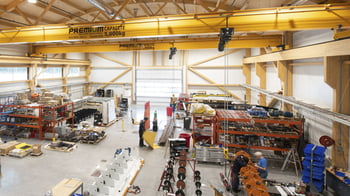
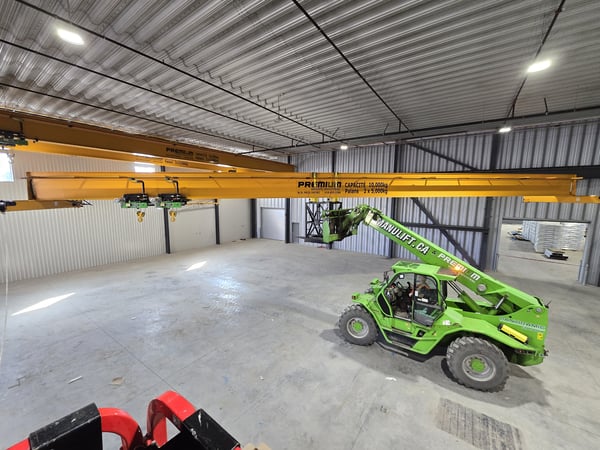
Machinery assembly
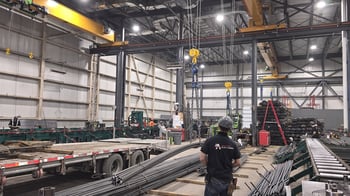
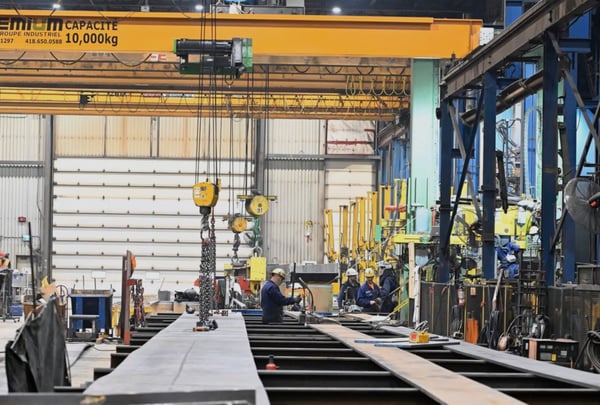
Steel loading and unloading
Lifting speed
Speed is also an important factor. For example, for regular loading/unloading operations in a production setting, the wire rope hoist will be preferable because of the greater speed options available.
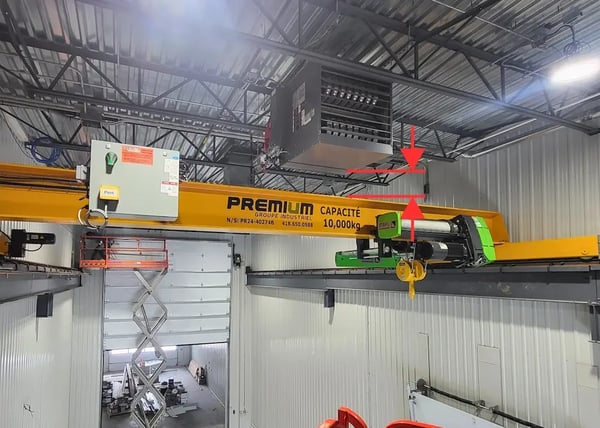
Hook zone cover
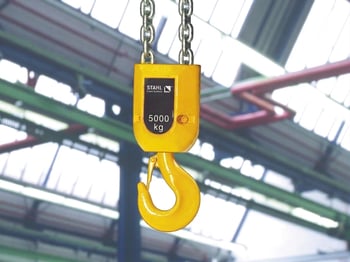
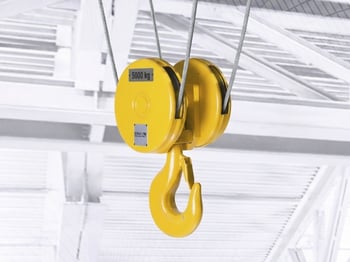
However, in terms of flexibility of approach with the hook, whether at horizontal or vertical ends, the chain hoist is often more advantageous. The small footprint of the hook allows it to get lower and enter tight spaces, such as the heart of an engine, which is ideal for industrial mechanics.
Vertical lift
For precise vertical lifts, chain hoists are ideal, as they are designed for “true vertical lift”, enabling the hook to rise without drift. However, for precise horizontal positioning, wire rope hoists offer a wider range of lifting speeds, enabling finer adjustments.
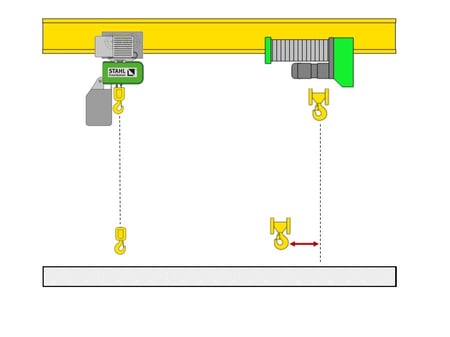
Hook drift occurs on the wire rope hoist as the rope winds onto the drum.
What’s the difference in price and maintenance costs?
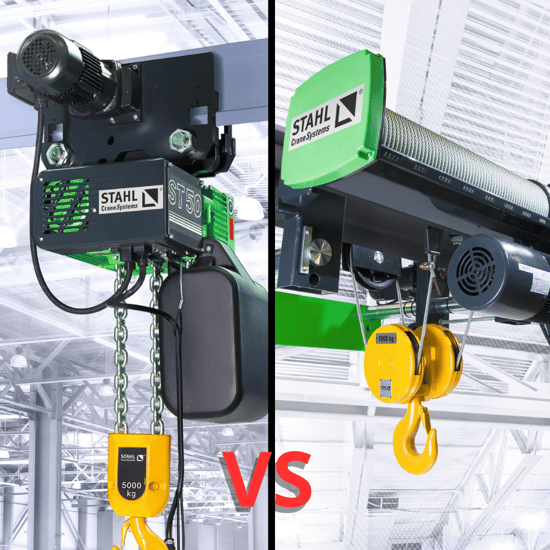
A chain hoist is generally more affordable to purchase because it has a simpler design, using a gear mechanism instead of a grooved machined drum. A wire rope hoist, on the other hand, often includes sensors and electronic components that increase its cost. On average for a 5 000 kg capacity wire rope hoist, you can expect to pay an additional $3,000 to $4,000 more than for a chain hoist.
In terms of maintenance costs, chain hoists are pretty similar to wire rope hoists, as well as their service life. For example, although the lifting chain is more expensive than a wire rope, it can last up to 30 times longer.
What are the differences between a wire rope hoist and a chain hoist?
The table below gives you a quick overview of the main differences between the wire rope hoist and the chain hoist.
| Features | Wire rope hoist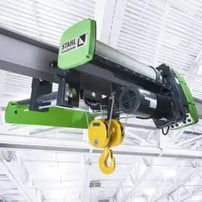 |
Chain hoist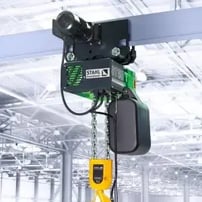 |
|---|---|---|
| Acquisition costs |
$$Higher |
$Lower |
| Maintenance costs | Similare | Similare |
| Design | Complex and bulkier, but without chain box | Compact and simple design, but the chain box can be bulky |
| Lifting capacity (standard) | 1 000 kg to 25 000 kg | 125 kg to 6 300 kg |
| Vertical lift | Extra charge to obtain a true vertical lift | Standard true vertical lift |
| Durability | Equivalent | Equivalent |
| Flexibility of approach | Varies by configuration | Better |
| General footprint | Higher (depending on configuration) | Reduced |
| Speed | Wid range of speeds | Limited range of speeds |
| Noise | Similar | Similar |
| Application examples | Steel distribution, concrete industries, structural metal manufacturing | Mechanical workshop, machinery manufacturer, wrought metals |
| Available accesories | Multiples | Limited |
| Suitable for automation | Yes | Limited possibilities |
Frequently asked questions
Which hoist should I choose to lift 5 tonnes?
At 5,000 kg, both options are valid and common. The choice then depends on the application: high lifting speed and frequent cycles favor wire rope, as in frequent steel loading, while access in tight spaces and true vertical lift favor chain, as in machinery maintenance or a mechanical workshop.
Does the chain of a hoist cause judder when lifting the load?
Rarely. Chain jump is usually caused by a maintenance issue, and like any at-risk situation, the equipment must always be properly maintained. But load movements during raising or lowering are rarely caused by the chain hoist. Other factors, such as beam deflection, have a much greater impact.
Are wire rope hoists more reliable ?
No. A wire rope hoist may be more common, but that does not make it more reliable. Here is why it is more widespread:
- More applications require wire rope hoists.
- Standard wire rope hoists can lift larger loads.
- In the past, chain hoists were less available
- Some suppliers may not have access to a range of industrial-grade chain hoists.
Are chain hoists noisier ?
Not necessarily. The noise level depends on the brand and quality of the equipment. For example, a Stahl wire rope hoist and its chain equivalent show similar levels, at 74 to 76 dB at a distance of one metre.
In conclusion
The wire rope hoist is not superior to the chain hoist, and vice versa. It all depends on the application and your specific needs. Knowing the differences between these two types of equipment will help you make the right choice.
Still unsure for your project? Our specialists analyze your application and recommend the best-suited solution.