
By Marc-André Martineau
Manager & Partner
at Premium Industrial Group
When you buy a car, the dealer might show you how it works. But that demonstration doesn’t replace a driver’s license.
The same logic applies to an overhead crane.
Yes, overhead crane operator training is mandatory. And it’s not the same thing as a commissioning demonstration. Although Premium Industrial Group does not currently offer comprehensive operator training, it can refer you to the right resource.
In this article, we answer three simple questions:
- Does Premium offer this service?
- Is the training mandatory?
- And how can you recognize training that is truly adequate?
Does Premium Industrial Group offer training for overhead crane operators?
No. Currently, Premium Industrial Group does not offer comprehensive training for overhead crane operators.
 However, we can refer you to SP Services-Conseils Prévention, a partner specializing in occupational health and safety training.
That said, when commissioning a new overhead crane, it’s recommended that the relevant personnel be present to receive a demonstration of how the equipment operates. This technical presentation is important for understanding how the overhead crane works, its specific features, and asking the right questions from the start.
However, it must be made clear: this demonstration does not replace the operator training required to use the overhead crane in a safe and compliant manner.
To better address the most frequently asked questions on this topic, we spoke with Simon Paradis, a prevention advisor and occupational health and safety trainer at SP Services-Conseils Prévention.
Interview with Simon Paradis on Overhead Crane Operator Training
Is overhead crane operator training mandatory?
Yes. In Quebec, an overhead crane may only be operated by an operator who has received theoretical and practical training from an instructor. Section 254.1 of the Occupational Health and Safety Regulation specifies this requirement.
More broadly, the Occupational Health and Safety Act (OHSA) supports this requirement. Section 51, paragraph 9, is clear: the employer must inform the worker of the risks associated with their work and provide them with the necessary training, instruction, and supervision so that they can perform their work safely.
What should a crane operator training program cover?
It must go beyond simply issuing a certificate.
Specifically, a comprehensive training program covers, among other things:
- lifting equipment and accessories;
- the specific characteristics of the work environment;
- operating methods;
- communication;
- inspection;
- rules applicable to lifting operations.
Watching a new overhead crane in operation during its commissioning is helpful. But that alone is not enough to qualify an operator.
Does this training need to be renewed?
Yes. And this applies not only to the operator.
The employer is required to ensure that its workers have the knowledge and skills to work safely. This also means keeping those skills up to date. That’s where refresher training comes into play. Section 51, paragraph 9 of the LSST directly supports this responsibility.
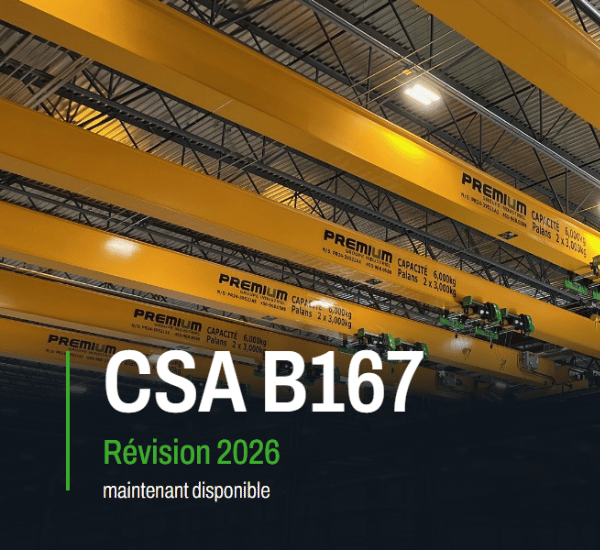
In addition, there is the CSA B167-16 standard. Its Section 9.3.1.6 is clear: refresher training must take place at least every three years.
In practice, this refresher training helps correct bad habits, review safe work practices, and maintain a high level of vigilance on the job site.
Does this principle also apply to other lifting equipment?
Yes. The same principle applies to jib cranes, gantry cranes, and monorails: workers must be trained based on the equipment used and the actual risks involved in their work.
How can you tell if a bridge crane operator training program is good?
Since this training is mandatory, the real question isn’t just whether it exists, but whether it’s truly appropriate for your specific situation.
Not all training programs are created equal.
The true value of a training program isn’t the certificate you receive at the end. It’s what your operators are capable of doing the next morning, in your plant, on your overhead crane.
Here are the key criteria to check.
1. Training Tailored to Your Specific Situation
The training should be designed based on:
- your overhead crane;
- your lifting accessories;
- your loads;
- your work methods;
- your actual work environment.
Training that is too general and not tailored to your operations is less valuable.
2. A Competent Trainer
The trainer must be proficient in lifting techniques, understand the risks involved in the field, and be able to teach both theory and practice.
Simply knowing the subject matter well is not enough. The trainer must also know how to convey that knowledge and relate it to real-world work situations.
3. Sufficient duration
A good training program takes the time to cover the essentials:
- inspection;
- controls;
- safety devices;
- moving the equipment with and without a load;
- checking accessories;
- rigging;
- safety practices specific to your operations.
Training that is too short is unlikely to produce meaningful results in the field.
4. Supervised hands-on practice in small groups
The practical component must remain sufficiently personalized.
In groups that are too large, learning becomes less effective, key questions are less likely to arise, and supervision loses its effectiveness.
In summary, good training isn’t just about meeting a requirement. It serves to reduce risks, improve behavior in the field, and prevent costly mistakes.
Key Takeaways
When a company seeks to determine whether training for overhead crane operators is mandatory, it’s generally not a theoretical question. It’s often because there is already a concrete issue involving compliance, safety, risk management, or responsibility.
Today, the answer is clear: yes, this training is mandatory. It cannot be replaced by a simple demonstration of the equipment or by experience gained over time. It must also be kept up to date, specifically through a refresher course at least every three years, in accordance with CSA Standard B167-16.
For employers, the challenge is therefore not just a matter of checking a box. It’s about ensuring that their operators are truly trained, that their training is still valid, and that it aligns with the reality of the work they are required to perform. This is also where the difference lies between a mere formality and a process that truly helps prevent deviations, errors, and avoidable accidents.
Premium Industrial Group does not currently offer this comprehensive training, but can refer you to SP Services-Conseils Prévention if you’d like to be connected with a specialized resource.
If you are in the process of verifying the requirements for your overhead crane operators, we can help you clarify what is involved in commissioning the equipment, mandatory training, and the next steps you should take.