
By Marc-André Martineau
Manager & Partner at
Premium Industrial Group inc.
Revision date : June 22, 2026
Before adding a below-the-hook lifting device to an overhead crane, three points must be validated: the total suspended load, hook compatibility, and how the device will be set down between uses. These three pitfalls come up very often, and they need to be addressed before the purchase—rarely after.
By the end of this article, you’ll know how to anticipate the three project mistakes that can cost you the most: unknowingly overloading an overhead crane, receiving a device that does not fit the hook, and leaving an accessory suspended because there is no parking stand. You’ll know what to validate—and what drawings or measurements to request —before signing the purchase order.
What are below-the-hook accessories used for?
Below-the-hook accessories are used to grip, stabilize, or position a load that the overhead crane hook can’t handle directly in a safe and productive way. Depending on the type of load (sheet metal, container, coil, structure, etc.) and the work environment, the right lifting device can improve the safety, speed, and quality of material handling.
Three pitfalls to avoid before buying
On the projects we see at Premium, three pitfalls come up time and again: leaving the lifting device’s weight out of the total load, failing to validate hook compatibility, and overlooking how the accessory will be set down. Each one should be addressed before the purchase, not after.
1. Why the lifting device’s weight changes your usable capacity
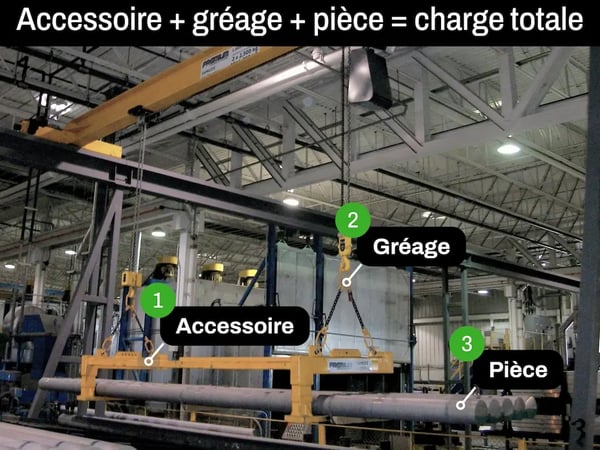
The capacity of an overhead crane —and of any lifting device—must cover everything suspended under the hook: the part being handled, the rigging, and the accessory used below the hook. If any of these elements is left out of the calculation, the risk of overload is real.
This issue is especially critical on lower-capacity equipment. On a 2-ton overhead crane, for example, a manipulator weighing a few hundred kilograms can take up a significant portion of the available capacity. The actual usable capacity—the part you want to handle—is reduced accordingly.
- systematically add the weight of the part, the rigging, and the lifting device
- verify that the rated capacity of the overhead crane, hoist, and hook covers the entire assembly, not just the part
- validate that the assembly’s center of gravity remains stable and compatible with the pickup point
2. How to validate hook compatibility
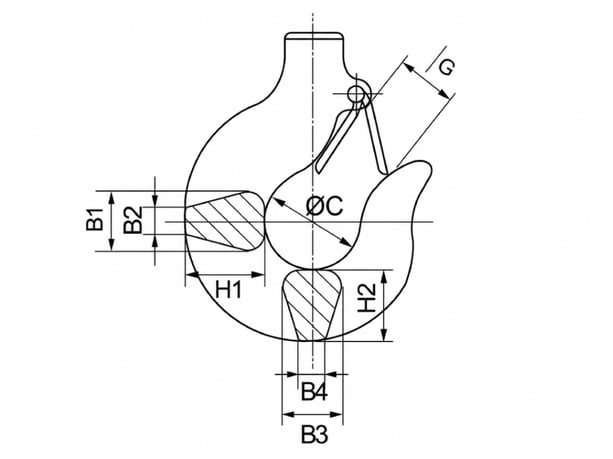
A below-the-hook accessory may seem suitable in theory and still fail to fit the hook in practice. Compatibility must be validated across several hook dimensions, not just the throat opening.
If the hook opening is not large enough for the device’s ring, shackle, or attachment point, the connection simply will not work. This can happen even when the throat opening seems adequate. These dimensions must be validated directly on the hook and device drawings, with support from your supplier.
At a minimum, check the following before buying :
- the device’s attachment point dimensions and hook opening, validated on drawings
- vertical clearances: the device adds height under the hook, which directly reduces the usable lifting height
- the device’s travel path in the work area (obstructions, structures, nearby equipment)
- a dimensional drawing or verified measurements, provided by your supplier
In our field experience, the clearest warning sign of a future problem is the absence of a dimensional drawing or documented measurements. A purchase based only on a photo, a sales sheet, or a verbal description is a purchase whose compatibility has not been validated.
One exception: a below-the-hook device supplied with the overhead crane by the same manufacturer may come with some of these verifications already documented. In all other cases, compatibility still needs to be validated before the purchase.
3. How to plan safe storage between uses
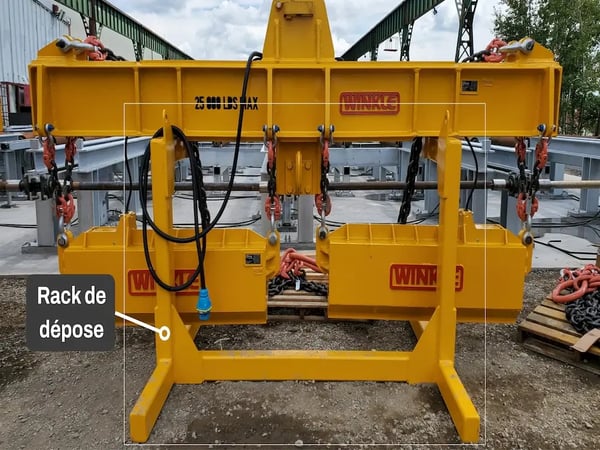
An accessory that is not used continuously must be set down safely. It cannot be left suspended. A suspended load, even temporarily, creates a risk and violates RSST regulations.
Beyond the regulatory risk, not having a proper storage location shortens the service life of accessories. Slings left dragging on the floor, for example, can quickly become damaged.
Plan for the following from the project design stage :
-
a dedicated parking stand or one integrated into the lifting device
-
a clearly identified and marked location in the work area
-
a simple procedure for setting down and picking up the accessory
In the field, the most common mistake is forgetting that the device needs to be set down. In that case, the operator has to improvise, and the accessory often ends up staying on the hook permanently.
What are the main families of below-the-hook accessories ?
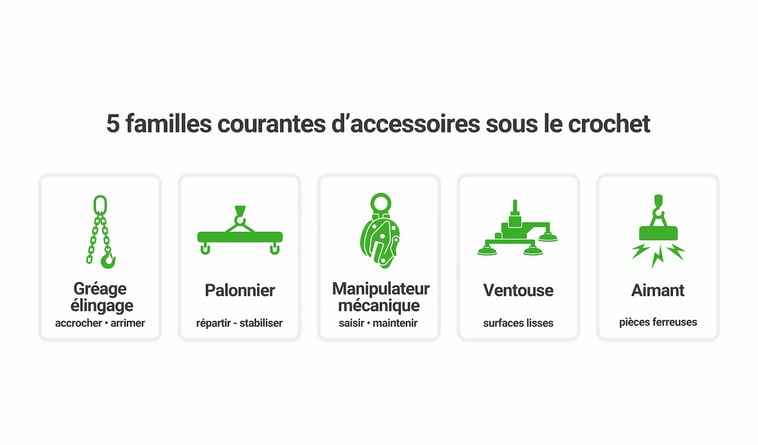
| Family | Power supply | What it's used for | when to consider it |
|---|---|---|---|
|
Rigging (slings, shackles, rigging spreader beam) |
None (manual) |
Connecting the load to the hook with flexible or rigid lifting components |
Varied parts, irregular shapes, occasional or low-repetition lifts |
|
Spreader beam |
None (mechanical) | Distributing the load across several attachment points and stabilizing the part | Long or fragile parts, or parts that require several lift points at the same time |
|
Mechanical manipulator (clamp, C-hook) |
None (mechanical) | Gripping a load directly without rigging and providing a repeatable pickup | Coils, plates, parts with standardized geometry, and high production rates |
|
Vacuum lifter |
Electric* | Gripping a smooth surface without marking it, using vacuum pressure | Sheet metal, plates, glass, composite panels |
|
Lifting magnet |
Electric* | Gripping ferromagnetic parts without rigging or a dedicated attachment point | Loose steel parts, plates, scrap, and material cutting |
* Electrically powered below-the-hook devices require special precautions from the design stage. You need to plan how power will be supplied to the manipulator (through a cable reel) and determine whether its controls will be integrated into the overhead crane controls or managed separately.
Should operator training -include accessories ?
Yes. Operator training is not limited to the overhead crane: it must also cover the accessories used below the hook.
The Regulation respecting occupational health and safety (RSST) specifies that training for a lifting device operator must include the accessories used with the device. In other words, an operator trained on the overhead crane but never trained on the manipulator or spreader beam used every day cannot be considered fully trained.
Useful training on these accessories covers at least :
- the visual checks to perform before each use
- the accessory’s operating limits (rated capacity, type of load, position of the part)
- the procedure for setting down and storing the accessory
- signs of wear or defects that require removing it from service
Like the overhead crane itself, lifting accessories are subject to the annual inspection requirements set out in the RSST.
In summary: three validations to check before buying
- Documented total load : pièce + gréage + accessoire ≤ capacité du pont, du palan et du crochet.
- Hook compatibility validated on drawings : attachment point dimensions vs. usable hook opening, plus vertical clearance under the hook.
- Planned storage between uses : adequate stand, ergonomic height, defined location in the shop.
If one of these three points remains unclear with your supplier, that is a sign to slow down the decision and involve a lifting specialist. Before signing a purchase order, these three validations must be documented.
|
**Preparing to add a lifting accessory? Before signing the purchase order, have an integrator validate the accessory’s compatibility with your installation. Premium’s team can review your hook drawings, calculate the actual available capacity, and recommend a parking stand suited to your shop. Let’s talk before you buy. |
The best accessory addition projects are the ones where these three validations are already complete before the first discussion with a supplier.
FAQ on lifting accessories
Does the weight of the rigging also count in the total load ?
How do I know if an accessory is compatible with an existing hook ?
Can an accessory be left suspended at the end of a shift ?
What standards govern lifting accessories in Quebec? ?
In Quebec, the use of below-the-hook accessories falls under the Regulation respecting occupational health and safety (RSST). For design and manufacturing, the industry relies on ASME standards recognized across North America: ASME B30.20 (safety, marking, inspection, testing, and operation) and ASME BTH-1 (design criteria, design factors, and service classes). CSA B167, for its part, applies to overhead cranes themselves, not below-the-hook accessories. A compliant accessory therefore combines Quebec’s regulatory obligations with these ASME standards.
Does a lifting accessory need to be inspected by a qualified person?
Yes. In addition to the visual checks that the operator performs before each use, the RSST requires periodic inspection of lifting accessories, just as it does for overhead cranes. This inspection must be performed at least once a year by a qualified person. However, the frequency must be increased when usage is intensive, the environment is harsh, or the type of load is demanding.