
By Jonathan Cadotte
Service Manager at
Premium Industrial Group inc.
Revision date : June 22, 2026
Do you have overhead cranes, jib cranes, or other lifting equipment in your plant that has “always been there”? Maybe a CNESST inspector is now asking for load test reports for that equipment. This is a situation we see regularly at Premium — and the answer is rarely simple.
What will Premium Industrial Group’s answer be? In general: no. But why?
Before answering that question, another one needs to be asked first : does your equipment file still contain enough reliable information to determine whether a load test can be performed responsibly?
That’s where things get complicated. In most cases, the necessary information is no longer available, is incomplete, or is not reliable enough to support a proper validation. Drawings may have disappeared long ago. Equipment may have been modified over the decades. The supporting structure is not always documented. The inspection history may be partial or nonexistent.
Without these elements, a load test on existing equipment can become difficult, very costly, or simply impossible to consider responsibly.
Because Premium Industrial Group manufactures and installs nearly 250 overhead cranes per year and proposes a load test on each of them during commissioning, we have developed significant experience in this area. Here are the elements to check before going any further.
The short answer: rarely without a reliable technical file
As you may have guessed, the answer is rarely a simple “yes.”
An incomplete file generally makes it impossible to properly evaluate the risk, the equipment’s actual capacity, or the capacity of the structure that supports it.
Before lifting a significant load, you need to be able to answer very concrete questions :
- What is the equipment’s actual capacity?
- Is that capacity documented?
- Can the structure supporting the overhead crane handle that load?
- Has the equipment been modified since installation?
- Does its current condition allow for a safe test?
- Is the available information still reliable enough to support a decision?
If these answers are not available, you simply do not know what you are about to test. And with lifting equipment, that uncertainty cannot be taken lightly.
What is required to perform a load test on an existing overhead crane?
Because a load test involves lifting significant weights, certain elements must be checked beforehand. And this is where things become much more complicated with existing equipment.
We often see overhead cranes installed 20, 30, or 40 years ago, whose drawings were lost after several changes in ownership, plant renovations, or internal modifications. The equipment still works, yes — but that does not mean its technical file allows for a responsible load test.
Here are the main elements you need to have on hand.
-
Sealed overhead crane drawings from a competent engineer
This may seem like a basic requirement, but while it’s easy to have this document for new equipment, it’s a completely different story for older equipment.
The sealed drawing generally contains important information: the rated capacity, the design standards used, and the deflection criteria. Without this document, it becomes very difficult to confirm the real design limits of the overhead crane.
-
Sealed drawings of the supporting structure
Even if an overhead crane was designed for a given capacity, that does not automatically mean the structure — and the floor it rests on — can support the same capacity.
This is even more true for a structure where overhead cranes may have been added over the years. It’s also important to make sure no modifications have been made to that structure, as any changes could affect its capacity.
-
The initial inspection report or the latest available inspection report
You need to confirm that the installation was completed according to industry standards and that the equipment has been inspected regularly since then.
Without these reports, the equipment's history is essentially unknown. In that context, it's difficult to evaluate what you are truly about to test.
-
A complete inspection of the equipment before testing
If “load-bearing” elements are worn to the point where they could potentially cause the load test to fail, the defects must be corrected before the tests are performed.
Testing equipment that is not in suitable condition is out of the question. A poorly prepared test can lead to deformation, failure, or a situation where responsibility becomes difficult to establish.
-
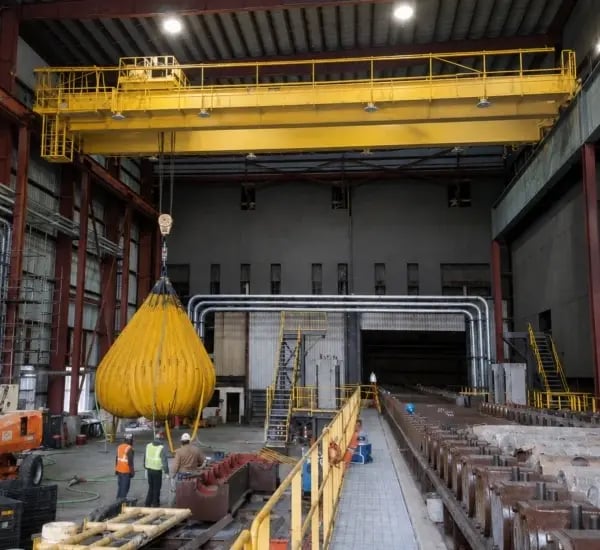
Weights equivalent to 100% and 125% of the rated capacity
A load test should not be done with “whatever is available.” Since the test is performed dynamically — the load must be moved in every direction — the test loads must be appropriate and planned in advance.
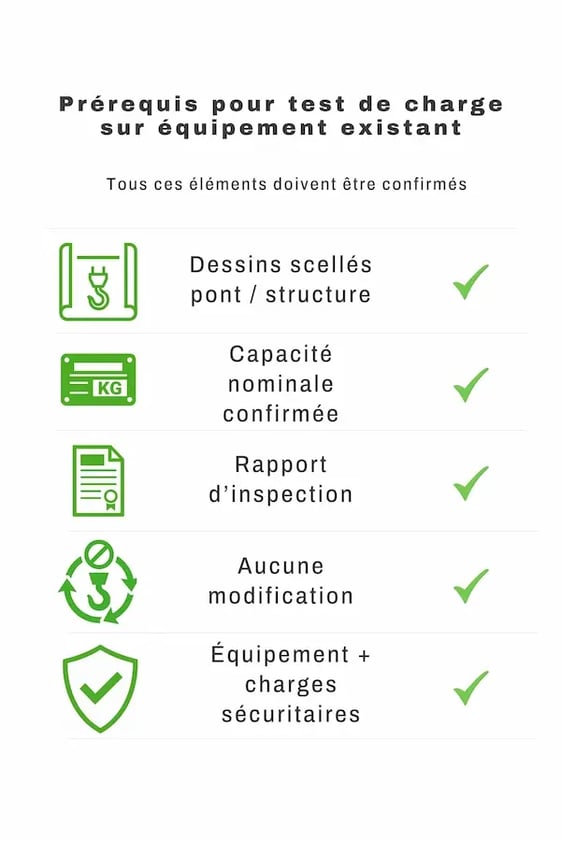
Once all these elements are in place, it becomes reasonably possible to perform load tests on existing lifting equipment. In practice, bringing together all these conditions is often very difficult, too costly, or simply impossible for older equipment.
What if you don't have all the documents?
This is probably the most common situation.
You don’t have the original drawings, inspection reports, or the complete equipment history? That is not automatically a dead end — but a load test should certainly not be the first step.
You first need to gather what actually exists :
- the documents available in your archives;
- the most recent inspection reports;
- information about modifications made to the equipment or the structure;
- known data about the rated capacity;
- observations related to the overhead crane's current condition.
You also need to accept an important reality: in many cases, documents have disappeared long ago, equipment has been modified over the decades, or the available information no longer makes it possible to validate the real condition of the system and its structure. Some information simply cannot be recovered.
In some cases, a preliminary equipment inspection can help clarify its actual condition before going further. Be careful, however: this inspection does not replace missing technical documents, and it does not guarantee that a load test can be performed.
In many cases, this information-gathering process quickly reveals that the file is not sufficient to go any further.
Before requesting a load test: your self-diagnosis
Before contacting a supplier about a load test on an existing overhead crane, start by answering these questions:
- Do you have sealed drawings for the overhead crane?
- Do you have sealed drawings for the supporting structure?
- Can you confirm the equipment's rated capacity?
- Do you have an initial inspection report or a recent report?
- Do you know whether the equipment or structure has been modified since installation?
- Does the equipment’s current condition allow the test to be performed safely?
- Can the required test loads be supplied and moved safely?
- Is the available information complete enough to properly assess whether a load test can be performed?
If several of these answers are unknown or impossible to confirm, your file probably cannot be evaluated properly for a load test. This is not necessarily a question of bad faith — it’s often a question of insufficient documentation, incomplete history, or validation that can’t be done reliably.
This filter can help you avoid wasting time, requesting an intervention too early, or receiving an answer that seems negative when it’s simply based on a lack of verifiable information.
In conclusion
In the past, load tests on existing equipment were rarely discussed. Today, organizations such as the CNESST and prevention mutuals are better trained and better informed. The fact that an overhead crane was installed in the 1970s does not exempt it from this requirement — even if it’s used every day.
In most cases, the information needed to determine whether a load test can be performed responsibly is no longer available. That’s often the real issue — not whether the supplier is able to perform the test.
If you are facing this situation, the best first step is to check whether you actually have the information and documents needed for such a process to be evaluated seriously.
Start with two simple elements: the original drawings and the latest available inspection reports. These documents will quickly help you determine whether your file can be recovered, or whether the missing information makes the evaluation too uncertain to go further.
Also note: even when a load test is technically possible, it does not automatically make an overhead crane “compliant.” A test confirms certain elements in a given context, but it does not replace a complete inspection, compliance, or engineering validation process. To better understand this distinction, see our article : Lifting equipment certification: What does it really entail?