
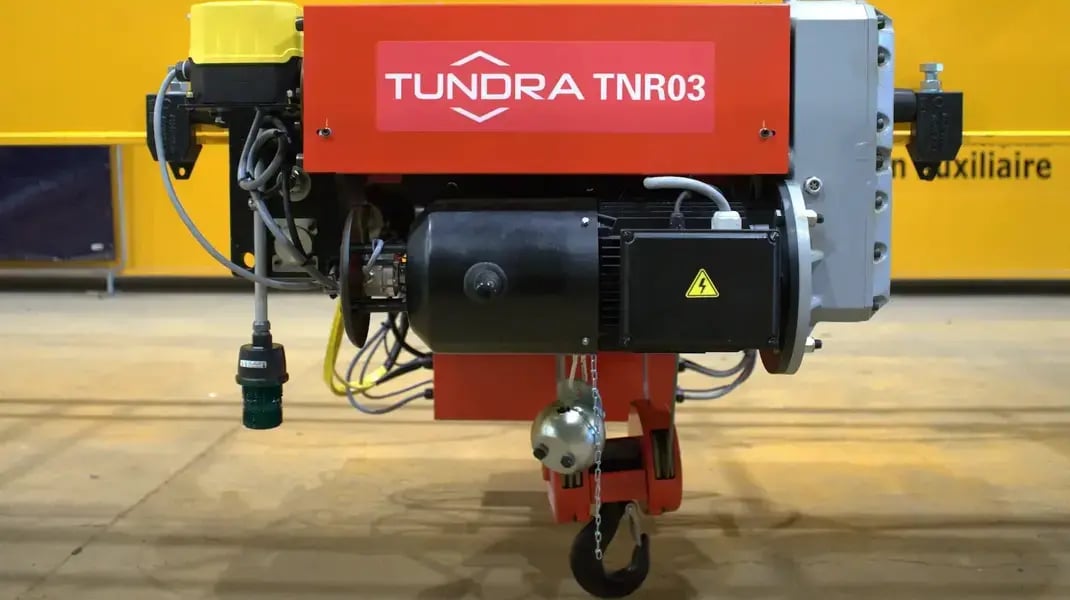
Tundra wire rope hoist:
Is it right for you ?

Like hoists from other brands, the Tundra wire rope hoist may be a good option for you depending on your lifting needs. Its strengths include value for money, precise control and ease of maintenance. Some buyers may hesitate because Tundra is new on the market. But is that a good reason to base your choice on?
Here are the questions this page will answer:
- Why might a Tundra wire rope hoist be a good option for you?
- What features make this equipment worth considering?
- When is a Tundra hoist not the right choice for you?
- The Tundra hoist is new to the market. What gives you reason to trust it?
Why might a Tundra wire rope hoist be a good option for you?
The following table will help you decide whether it's worth taking a closer look at the Tundra wire rope hoist.
| You are looking for… | Tundra offers… |
| Value for money | A quality product with advanced technology options (such as VFDs) at a very competitive price. |
| Precise control | A variable frequency drive (VFD) included as standard for both hoisting and travel. |
| Ease of maintenance | Any competent technician can service the equipment, including its VFDs, without involving a Tundra MH technician. Spare parts are available in Quebec. |
For more information about variable frequency drives, we recommend the article Speed drive vs contactor: What to choose for my overhead crane?
Here are some other product features:
| Feature | Specifications |
| Available models | TWL: low-headroom hoist, monorail trolley, single girder, up to 15 metric tons. TWL & TWR : low-headroom hoist, double-girder trolley, from 5 to 50 metric tons. |
| Capacity range | 3 to 50 metric tons. |
| Hoisting speed | 3.6 to 18 m/min. |
| Travel speed | 14 to 48 m/min. |
| Voltage | 460 V and 575 V. |
| Available technologies | Wireless radio remote control; adjustable trolley opening to fit the beam; electrical kits configurable to suit the project. |
| North American service class | ISO M5 and M6 (~CMAA/CSA classes C and D). |
| Certification | CSA certification for Canada and the United States. |
| Design standards | ISO and EN standards. |
| ASME requirements | The products exceed the requirements of ASME B30.16. |
| Limit switches | Dual hoisting limit switches with emergency cut-off at the upper limit. Adjustable to suit the application. |
When is a Tundra hoist not the right choice for you?
The following table explains why a Tundra hoist may not suit your needs.
| Less suitable in these situations | Why |
| You need highly reliable equipment for environments with specific requirements, hazardous environments or outdoor use (cold, heat, humidity, explosion hazards, etc.) | Other wire rope hoist brands are better suited to these conditions. Some options are not offered by Tundra MH (e.g. explosions-proof hoists) |
| You are in a remote area, or you want technologically simple equipment that is straightforward to maintain. | Although Tundra hoists are straightforward to maintain, less complex equipment often requires simpler parts that are available locally (e.g. contactors). |
| Your application requires a hoist with a capacity of more than 50 tons | Not currently available from Tundra MH |
| You want a stationary hoist (without a trolley) | Configuration not currently available from Tundra MH |
The Tundra hoist is new to the market. What gives you reason to trust it?
Premium's experts have been involved in designing this equipment for the past two years. As the table above shows, this hoist meets all Canadian industry standards and goes beyond them.
Is there evidence that the product is reliable and well made?
The following data can help you form your opinion:
As of September 22, 2026, 24 Tundra wire rope hoists had been sold. Of these, one unit had experienced a fault. Two parts needed replacement: one encoder and one brake. Both parts were in stock in Quebec and were replaced quickly. For context, the brake that was replaced was one of more than 60 brakes across the 24 units.
We'll update these figures as more information becomes available.
Who is Tundra MH?Tundra MH is a Quebec company headquartered in Terrebonne. It designs, develops, assembles, markets and services Tundra-brand hoists in Canada. It partners with Craftsman Automation, an Indian company that manufactures hoists and lifting components, including components for Tundra hoists. |
| Item | Information |
| Brand | Canadian |
| Design and development | Quebec & India |
| Marketing | Quebec |
| Assembly | Quebec & India |
| Technical support | Quebec |
| Manufacturing | India, by Craftsman Automation |
| Parts inventory | Quebec & India |
| Warranty | 2 years |
The Tundra wire rope hoist: an option
worth considering
Tundra deserves to be considered alongside other brands when its advantages match your application's needs. If you are looking for precise control, good value for money and straightforward maintenance, a Tundra wire rope hoist could be a good option. Consult a Premium specialist to review or confirm your choice.
Consult a specialist
However, if you're unsure whether Tundra is the right option for you, the pages on Stahl and GH will help you continue your comparison.
FAQ
01.
Is a variable frequency drive included as standard?
Yes. The Tundra wire rope hoist includes a variable frequency drive as standard for both hoisting and travel. This technology provides more precise control of movement (see the article Speed drive vs contactor: What to choose for my overhead crane? )
02.
Is the Tundra wire rope hoist straightforward to maintain?
Yes. A competent technician can maintain the hoist, including its variable frequency drives, without needing to call in a Tundra MH technician. Spare parts are available in Quebec.
03.
Does the Tundra wire rope hoist meet the applicable standards?
Yes. Tundra hoists are CSA certified for Canada and the United States. They are designed to ISO and EN standards and exceed the requirements of ASME B30.16. Their North American service class corresponds to CSA B167 Class C for ISO M5 and Class D for ISO M6.